
Smith + Byatt
Their fights are dusty but have rules


The Fraud, Zadie Smith [Penguin]
The Children’s Book, A.S. Byatt [Vintage]
Has your mind been throughly trashed by reading on the phone? Zadie Smith’s new novel, The Fraud is for you. Her chapters are short, focused and many (the NYRB pegs it at 200). It’s also her first foray into the historical novel (unless the return of ‘90s brown as a power color means you consider her 2016 novel Swing Time to be vintage).
Smith resisted the idea of writing about the past so much it was a motivation to reside in New York:
I kept clinging to the one piece of data about which I felt certain: any writer who lives in England for any length of time will sooner or later find herself writing a historical novel, whether she wants to or not.
Smith’s novel takes place in the late 1800s, and most of its characters were real people.
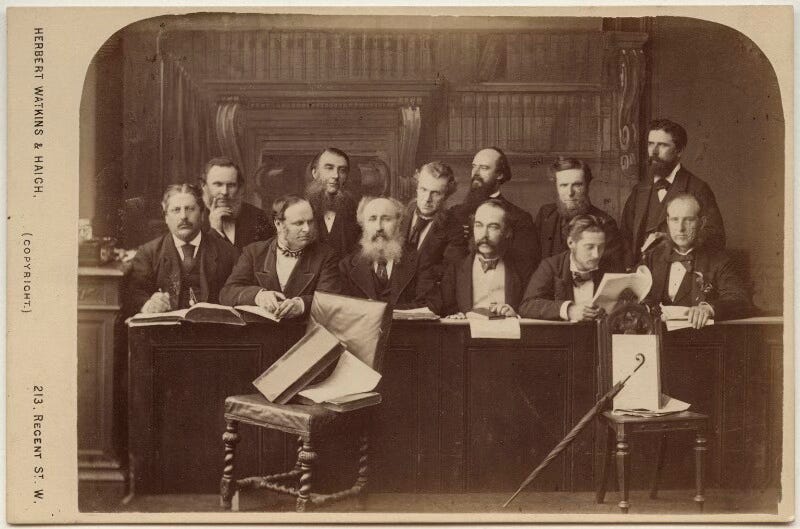
A claimant to the Tichborne fortune whose court case dragged on for eight years, to the absolute delight of Victorian England, who followed it like a season of Love Island. A novelist, William Ainsworth, who was a commercial rival to Charles Dickens. His housekeeper-cousin whose copy of A Christmas Carol was auctioned by Christie’s in 2009.
Smith writes the 1800s with class and race and gender at the center rather than the margins. Our guide is Eliza Touchet, the housekeeper-cousin to Ainsworth:
a widowed and childless dependent, attracted to both women and men, smarter than anyone around her, and increasingly troubled by the imperial crimes of a country in which she has never had a voice.
The modern slips in with the details. Sex is written with the same matter-of-factness as the coming of the post. Eliza chafes against her position, but (as most of us do) accepts it.
Eliza and Ainsworth’s second wife are drawn into the Tichborne case. The Claimant is a Trump-like figure, whose appeal continues despite, or perhaps because of, the mounting evidence of his untruths.
The crux of the novel comes when Eliza meets Andrew Bogel, a former slave turned attendant to the Tichborne estate who supports the Claimant. Bogel shares his story with Eliza over a meal, and profoundly shifts her conception of the British Empire:
Indeed, it seemed to her now that the two islands were in reality, two sides of the same problem, profoundly intertwined, and that this was a truth that did not have to be sought out or hunted down, it was not hidden behind a veil or screen or any kind of door. It was and had always been everywhere, like weather.
Every review of the novel I’ve read argues Smith is fighting against her own outsized reputation as a literary wunderkind. Is the historical novel—even with its modern echos, too much?
Michael Gorra in the NYRB thinks The Fraud is “the work of a writer in transition,” Ayesha Siddiqi (thank god Bookforum is back) thinks Smith “mistakes underwriting her own characters for the integrity of not telling her audience how to judge them.” Andrea Long Chu holds that “the irony of Smith’s career is that she has never actually excelled at constructing the kind of sympathetic, all-too-human characters she advocates for.”
I ended up glad Smith had written a meaty novel that has something to say about populist figures and authenticity that garnered multiple long reviews. In the novel, Ainsworth and Eliza both long for the time when they were at the center of a literary circle that sat around debating ideas. In picking up the historical form, Smith has summoned exactly such a conversation.
—
A.S Byatt’s The Children’s Book picks up right where Smith leaves us. Byatt opens her 2009 novel in 1895, with a lushly (nearly Ainsworthian in detail) description of lady writer Olive Wellwood touring the still-in-construction Victoria and Albert Museum.


Olive is given the tour by former solider Prosper Cain. Their two families, along with friends and lovers, move through the Edwardian Age and the First World War. The role of our lead has been flipped: Eliza is helpmeet to her writer-cousin, while Olive has arranged her husband, sister and children as accessories to her craft.
Byatt’s canvas is huge, but she returns again and again to the sacrifices that come with making art. At one point Prosper’s daughter Florence debates her future with Olive’s niece, Griselda:
“Do you not think it might be harmful to ignore the sex instinct? Don’t you think that after twenty years of studying Cinderella you might be seized by the idea of the children you never had?”
“Quite probably,” said Griselda […] “But after twenty years of childbearing and fever and confinement and being shut in a house I might be seized by the idea of Cinderella.”
Many of those who reviewed the novel got bored of the amount of pages Byatt spends describing historical scenes. Byatt, like Smith, relies on real people for her characters. Olive borrows her profession and her messy love life from E. Nesbit, who adopted two of the children fathered by her husband with another woman. Rupert Brooks and Oscar Wilde appear, as do events like the 1899 Paris Exposition.
Byatt started her historical novel with the idea of how childhood changed in the late Victorian era. That it spread into something larger is part of the trade off of being in Byatt’s world:
Ideally, she said, novels are like metaphors in which everything connects, and she gets indignant when people accuse her of dropping in bits of information for their own sake. “They’re not there to instruct or entertain the reader,” she said. “They’re part of the web.”
I adore Byatt. I’ve re-read The Children’s Book more times than I can count, including in the bath on my wedding day. It was the novel I reached for when I heard the news of her death.
A.S. Byatt is perhaps best known in the U.S. for Possession, which won the Booker in 1990 and was adapted into a frothy Gwyneth Paltrow vehicle in 2002. She was also an accomplished literary critic who trashed Harry Potter before it was popular. Her Frederica Quartet—particularly the second novel, Still Life—is criminally under-read.
Byatt’s London feels white and upper class after hanging about the Tichbourne trial and the down-at-heels Ainsworth household with Smith. But both writers ground their novels in how ordinary people reconcile our desires with the world.
Smith ends The Fraud without a clear conclusion: “The pieces seem even less tightly bound as we approach the end; the different bits begin to fly apart.” By the time I reached the end of my re-read of The Children’s Book, I realize Byatt has done the same.
Most of her Victorian adults have been swept off stage, replaced by their children. World War I resets everyone again, and we are left with a handful of people warped by the Victorian Age, and smashed by the First World War.
Both novels lure us in with the past and then tell us stories that are all too familiar: Smith’s Trump-like figure who thrives as his story disintegrates. Byatt’s generation shattering war. Long-live the historical novel and its ability to force us to look our sins right in the eye.